
Getting started
What does a supporting artist do?
A supporting artist—often called an extra—helps bring a scene to life without taking a main speaking role. You might appear as a shopper, commuter, guest, hospital visitor or period character. It is professional work, and productions rely on supporting artists to follow direction, stay focused and make every scene believable.
Who is a good fit for this kind of work?
People who are punctual, patient and comfortable with changing plans tend to enjoy it most. Filming can mean early calls, long periods of waiting and late finishes, so you will need enough flexibility to keep a full day free. A calm, friendly and professional attitude matters just as much as your appearance or experience.
Do I need acting experience to join Celex?
Celex considers applicants with acting, drama or performance experience. We may also consider relevant experience in areas such as dance, singing, modelling or promotional work. Your initial application needs a CV showing your relevant experience or qualification.
See the latest application criteriaHow old do I need to be?
Celex represents adults aged 18 and over. We do not accept applications for children or young people under 18.
Will joining guarantee me regular work?
No agency can promise a set number of jobs. Casting depends on each production’s brief, including location, age range, appearance, measurements, skills and availability. Keeping your profile accurate and replying promptly gives the team the best chance of putting you forward when you match.
Applications & DBS
How do I apply to Celex?
Start with the short application on our New Artists page. You will need a headshot, a full-length photograph and a CV outlining relevant performance or promotional experience. If your first application is successful, we will email you an invitation to complete the full registration.
Start an applicationWhat file types can I upload?
Photos must be JPEG, JPG, PNG or GIF files and can be up to 10MB each. HEIC images from some phones are not compatible, so convert them before uploading. Your acting CVcan be a PDF, DOC or DOCX file.
When will I hear about my application?
Applications are reviewed by the team, not automatically. Successful applicants are normally contacted by email within two to four weeks. If you have not heard within that time, your application has not been accepted on this occasion; however, you are welcome to try again after three months.
Should I get a DBS before applying?
You can wait until Celex accepts your initial application. You will then need to upload a valid DBS certificate before your registration can be completed. Existing artists must keep their DBS evidence up to date to remain active.
Read the full DBS guidanceWhere should I apply for a basic DBS?
Use the official GOV.UK service. Third-party websites may charge much more and their documents may not be suitable for verification. Keep the original certificate safe and upload a clear, readable image to your profile when asked.
Apply through GOV.UKHow often does my DBS need updating?
Celex asks artists to provide a new certificate every 18 months, or annual proof of a valid DBS Update Service subscription. If your evidence expires, your profile may be made inactive until its replacement has been checked.
Can I use a standard or enhanced DBS?
Yes, but Celex normally treats it as current for 18 months unless it is linked to an active Update Service subscription. If you use the Update Service, upload both the certificate and clear proof that the subscription is current.
Availability & bookings
How will Celex contact me about work?
Work enquiries and booking information may be sent by email, text or phone. Keep your details current and check your messages regularly, including junk folders. Always read the full request before replying so you understand the dates, location and special requirements.
What is an availability check or pencil?
It means Celex is checking whether you could work on a possible date. A pencil is provisional booking and is not a confirmed job. Reply accurately and keep the date available if requested, but do not travel to the location unless the booking is formally confirmed.
How do I know when I am definitely booked?
You are booked only when Celex uses the word “book” or “booking” and sends a clear confirmation. The final call time and exact meeting point often arrive close to the filming date because production schedules continue to change.
How much time should I keep free?
Unless the booking says otherwise, use Celex’s 7am–7pm rule and keep the full day available. Calls can be earlier and shoots may run later. Final call times are commonly sent between 5pm and 8pm on the day before filming, and you must acknowledge them promptly.
What if I can no longer make a confirmed booking?
Tell the named Celex contact immediately. A production plans its scenes around every confirmed person, so disappearing or cancelling late can cause serious problems. Genuine emergencies happen; quick, honest communication gives the team the best chance to find a replacement.
Do I need my own transport?
Not for every job, but it can make a big difference. Film locations are not always close to public transport, and call or finish times may fall outside normal service hours. Before accepting, make sure you can reach the location reliably at the required time.
Travelling to unitbases and locations
- You must always be prompt and allow plenty of time to travel.
- In case of emergency, you are lost or delayed, please call the Celex mobile.
- In the event you cannot attend a job, you must give us as much notice as possible - even if it a call in the middle of the night, as we would have to find a replacement for you.
- Expect that you may have to drive from the base to a location.
- We recommend you take a small cash float, to cover any unexpected parking, canteen or miscellaneous expenses.
- Please keep your mobile on whilst travelling, in the event that we, or the 2nd AD need to contact you.
- Please download the What3Words app (see next section).
- Go alone – under no circumstances must another person/child/pet be taken to any job along with you –if you are relying on a lift please be aware that they will not be allowed to hang around at the unit base or studio whilst you are working – this is a dismissible offence.
- Find the AD to report to when you arrive and check in.
What is the What3Words (W3W) app?
We will always give you a full address of the location but it is your responsibility to plan your route ahead.
Do not rely solely on a SatNav and postcode.
Wherever possible, we will provide your with the "What3Words" address.
This is most accurate way to direct you and it will give you a pinpoint location of 3m×3m. This meand for remote locations it can direct you to the exact gate or entrance to enter through.
We strongly recommend you download the app, or you will risk getting lost or delayed.


Useful apps and resources
What3Words:
Navigate to precise locations with a 3 word code referenced on your call sheet.
Never get lost again!
WhatsApp:
A must have for making contact with us quickly and efficiently and sharing photos & videos with us
Use WhatsApp Web to share files using your Windows or Mac computer. Very handy for downloading forms from WhatsApp, rather than relying on email.
(Requires WhatsApp to be installed on your phone)


View, fill and sign PDFs
Capture any paper document abd transform it into a high-quality PDF. A must have for uploading DBS certificates
Photos & profile
Measurement Guide
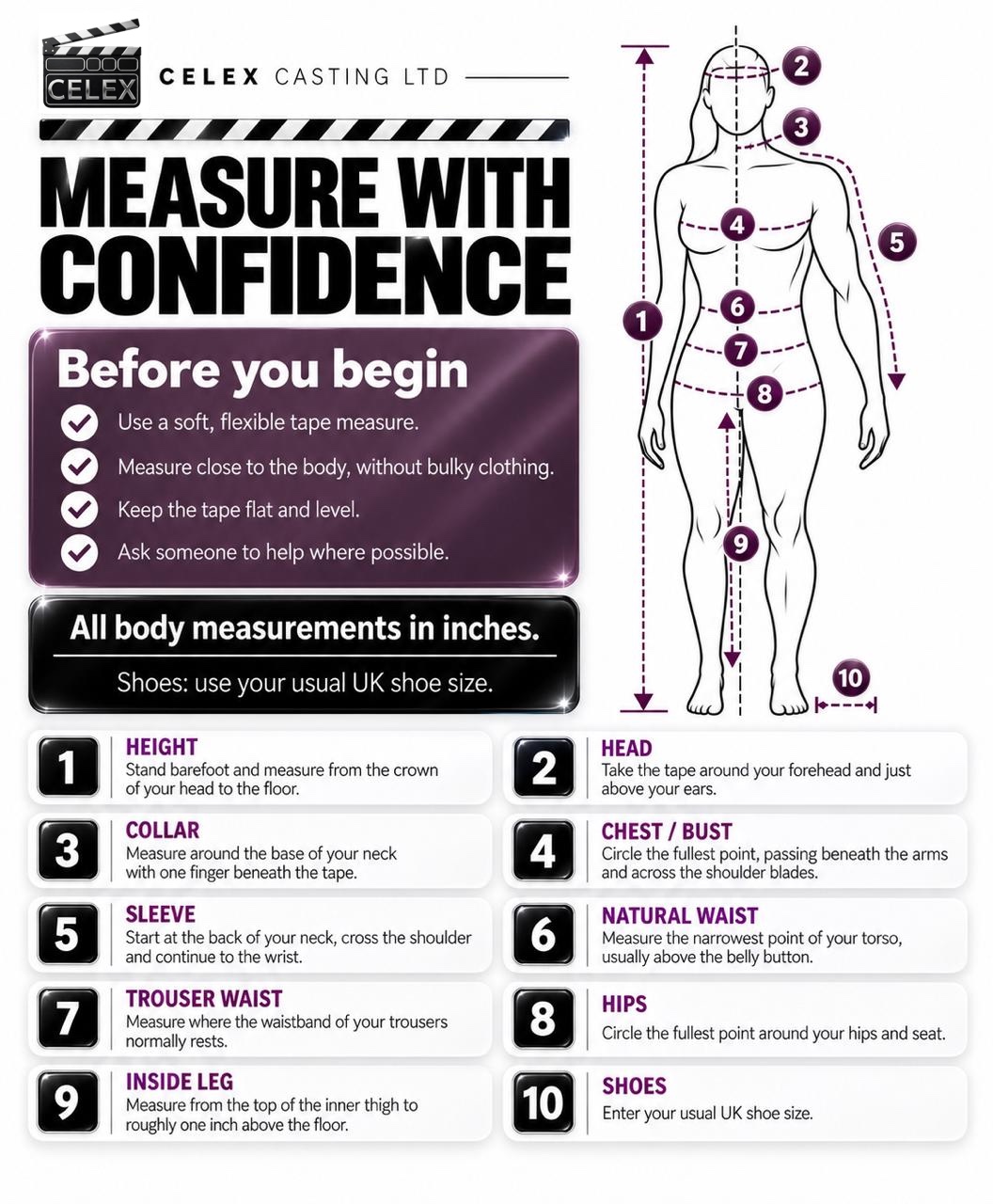
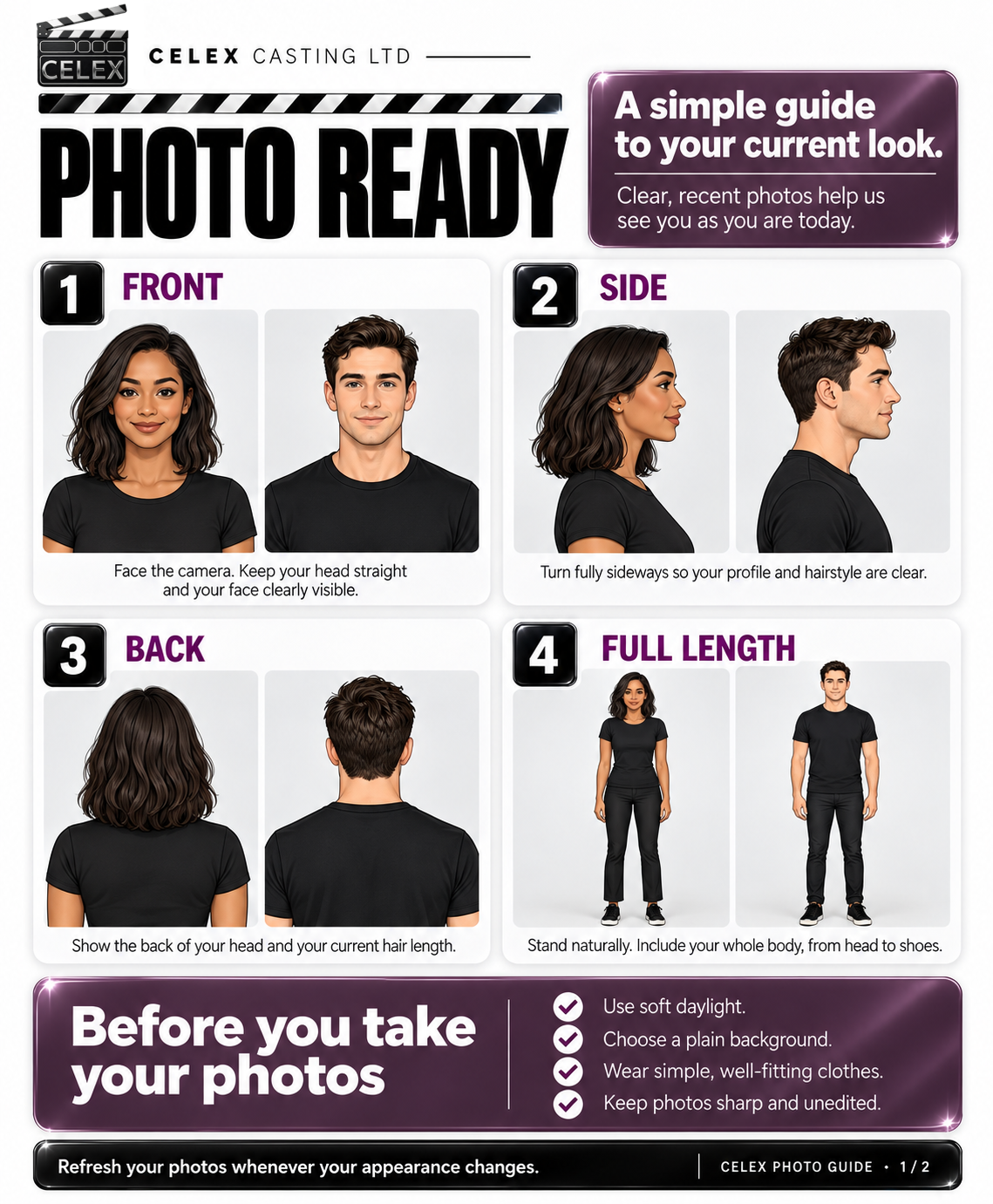
Photo Guide
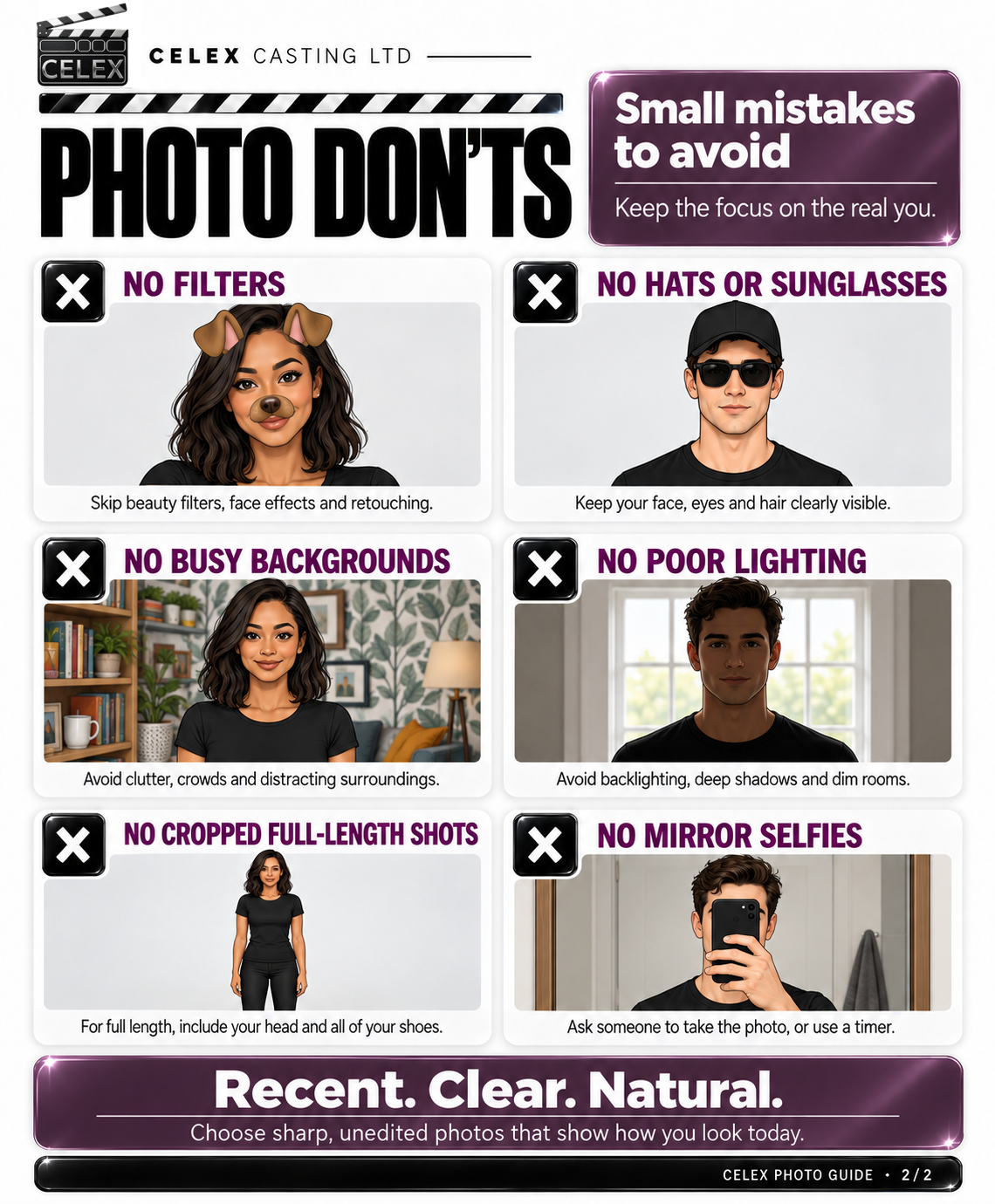
Do my photographs need to be professional?
No. A recent smartphone photograph is fine if it is sharp, well lit and honest. Stand against a plain background in natural light, wear a simple top and avoid filters, sunglasses or heavy editing. Your headshot should show your face and full hair length clearly.
Why do my measurements need to be accurate?
Costume teams use them to decide whether existing wardrobe will fit. Guessing or using old measurements can cost you a booking and may cause problems at a fitting. Use a tape measure and update the figures whenever your size changes.
When should I refresh my profile?
Update it whenever your appearance, contact details, measurements, skills or availability changes. New hair colour, facial hair, visible tattoos and significant changes in weight should all be reflected promptly.
I worked with Celex years ago. How do I return?
If you have not worked with Celex since March 2022, apply through the New Artists page using the current criteria. More recent artists can sign in to review and update their existing profile.
Go to artist loginWorking on set
What should I bring with me?
Follow your booking message first. Useful basics include photo
ID, requested wardrobe, comfortable layers, a waterproof coat,
a refillable water bottle and something quiet to do while
waiting. Pack for the weather and label personal items where
practical.
Always take medication with you and inform us if you have any allergies. Allergies should also be reported to the AD on arrival and inform them of the location of your EpiPen should you have one. For Spring and Summer shoots, SPF based sunscreen & non-drowsy antihistimes are always a good idea.
Taking snacks is recommended, especially if you are diabetic or suffer from reactive hypoglycaemia (low blood sugar).
Will food be provided?
Productions will normally explain the catering arrangements.
Meals or refreshments are often provided on longer calls, but
bring water and a small snack unless instructed otherwise. Tell
Celex about serious dietary needs before the job.
If in doubt, always take your own food, especially if you have strict dietary requirements or allergies.
Taking snacks is still recommended, especially if you are diabetic or suffer from reactive hypoglycaemia (low blood sugar).
Can I take photographs or post about the production?
No. Sets are confidential workplaces. Do not photograph costumes, locations, paperwork, cast members or anything happening behind the scenes, and do not share production details online. You may be asked to sign an NDA and store your phone during filming.
What behaviour is expected on set?
Arrive early, check in as directed and listen carefully to the assistant directors. Be polite, patient and ready when called. Keep conversations quiet in holding areas, never approach principal cast for photographs and raise any concern with the correct production contact.
Will I need to supply my own clothes?
For contemporary scenes you may receive a wardrobe brief and be asked to bring several options. Period or specialist costume is often supplied, sometimes after a separate fitting. Bring only what the brief requests.
What do common words and phrases used on set mean?
Film sets have their own language. Here are some some of the terms you are most likely to hear as a supporting artist:
- Action
- The cue for the main performance in the scene to begin. Continue following the instructions you were given.
- AD
- Assistant director. The AD team organises the filming day and gives supporting artists their instructions.
- Background action
- The cue for supporting artists to begin their instructed movements or actions.
- Call time
- The time you must arrive and report to the specified meeting point. Aim to arrive early.
- Chit
- The paper or electronic record of your attendance, hours, role and applicable payments. Check the details carefully before accepting or signing it.
- Continuity
- Keeping your clothing, appearance, props and movements consistent between different takes of the same scene.
- Costume fitting
- An appointment where the costume team selects and fits the clothing you will wear during filming.
- Cut
- Filming has stopped. Stay in place and wait for instructions rather than immediately leaving the set.
- First positions
- Return to the position where you began the scene.
- Holding area
- The place where supporting artists wait when they are not needed on set. Stay nearby and listen for instructions.
- Mark
- The precise place where you have been asked to stand or stop during the scene. You may hear this referred to as “your mark”.
- Pick-up
- Refilming a small part of a scene rather than repeating the entire sequence.
- Reset or back to one
- Return to your original starting position so the scene can be filmed again.
- SA
- Supporting artist.
- Standby
- Be ready and remain quiet because filming is about to begin.
- Take
- One recorded attempt at filming a scene. Several takes may be needed.
- Turning over or rolling
- The cameras and sound equipment have started recording. Stay silent and wait for your cue.
- Unit base
- The main production area where facilities such as catering, costume, hair and makeup may be located.
- Walk-through
- A practice of the scene’s movements without fully filming it.
- Wrap
- Filming has finished. Do not leave until production has formally released you and you have completed the signing-out process.
Pay & commission
Is all Celex work paid?
Yes. The applicable rate depends on the production, agreement, role, hours and any additional requirements. The work enquiry or booking will explain the rate being offered. Celex also publishes current commonly used Equity rates for reference.
View current rate informationDoes Celex charge a joining fee?
No membership or registration fee is charged. Celex’s currently published Artist Terms list a 17.5% commission deduction from eligible earnings and a £2.50 administration fee per booking or engagement. Check the current terms for full details, including which expenses are excluded.
Read the Artist TermsHow does overtime work?
That depends on the agreement covering the production. Your booking information should show the basic attendance period and the point at which overtime becomes payable. Keep an accurate note of your call, meal and wrap times, and follow the production’s signing-out process.
When should I expect to be paid?
Payment time varies because the production company must first process and pay the agency. Celex then processes your payment after receiving cleared funds. Check that your bank details are correct; an incorrect account number or sort code will delay payment.
Am I employed by Celex?
No. Under the Artist Terms, the production company is the employer for each engagement and artists are treated as self-employed for Income Tax and National Insurance. You are responsible for your own records and any tax return or payments that apply to you.
Try a shorter search or choose another topic.